🇮🇹 Original in Italian
Belvedere Marittimo (Cosenza): The Third Edition of the Summer Peace University Comes to a Close
The 2026 edition of the Summer Peace University came to a close on 16 October in Belvedere Marittimo. Since 2009, the initiative has brought young people from around the world to Calabria, with Belvedere Marittimo serving as its host city for the past three editions. Promoted by the Calabrian Institute of International Policies (IsCaPI), chaired by Salvatore La Porta, in partnership with the Municipality of Belvedere Marittimo and an international network of universities and cultural institutions, SPU26 offered an advanced educational programme which, under the theme “Humanity at a Crossroads: Education and Leadership for a Sustainable Civilisation”, explored some of the most profound contradictions of our time. At its heart was a question that will shape our collective future: what responsibilities are we prepared to assume to make peaceful coexistence possible, grounded in human dignity, respect for different identities and cooperation among nations?
The “Learning by Living” approach
The SPU educational approach, known as Learning by Living, was developed under the scientific coordination of Professor Pavel Malyzhenkov, alongside Professor Taha Mattar of Galala University, Coordinator for Africa and the Middle East. Together, they shaped an educational experience in which knowledge and responsibility were constantly intertwined, moving beyond the boundaries of traditional teaching to transform learning into practical experience. Lectures, direct engagement with professors and shared activities fostered a learning process that extended into everyday life, the relationships formed among participants and their interaction with the local community.
Addressing the defining challenges of our time
This educational journey drew its substance from disciplines that, when considered separately, may appear to speak different languages, yet through dialogue revealed just how closely interconnected the major challenges of our time truly are. Professor Spartaco Pupo of the University of Calabria guided students through the dynamics of power and the dilemmas of the international order, while Professor Ahmed Elshazly of Heliopolis University focused on the relationship between community security, the environment and shared resources. Professor Amedeo Argentiero of the University of Salerno broadened the discussion to encompass multipolarity and Indo-Pacific strategies, while Professor Radwa Ibrahim Ali Hassan Ali of Galala University addressed information integrity and cognitive security, highlighting how conflicts can be fuelled not only by material interests, but also by perceptions, narratives and the difficulty of acknowledging the realities of others.
Social responsibility, participation and institutions
The discussion then turned to the foundations of lasting cooperation, from the relationship between social accountability, participation and institutions, explored by Professor Shadwa Esmat of Galala University, to the opportunities presented by South-South cooperation and relations among emerging economies, examined by Ana Moran of I.B.A. Uruguay. These perspectives were complemented by the contribution of Professor Przemysław Pawlak, who guided students through the transition from ideas to project development, emphasising that even the most generous vision requires clear objectives, resources and practical tools if it is to make a meaningful difference. In this way, cooperation can move beyond an abstract principle and take shape through informed decisions, relationships to be cultivated and initiatives capable of becoming reality.
Yet not everything can be understood through politics and economics alone, as demonstrated by the “Art as a Universal Language” workshop. Professor Domenico Michele Surace of the Academy of Fine Arts of Reggio Calabria introduced the principle of Concordia discors, the harmony of opposites, to illustrate the possibility of achieving mutual understanding without erasing differences. Professor Mariacarmela Passarelli of the University of Calabria, meanwhile, explored the relationship between cultural heritage, territorial identity and innovation. The discussion resonated deeply with the participants’ own experiences, revealing that mutual respect does not require abandoning one's history, but rather learning to bring it into dialogue with that of others.
The future of technology
The future of technology also became part of this wider conversation through the contribution of Professor Rania Mohamed Abdelmageed Abdelaziz of May University in Cairo, who examined human values in the age of innovation and led the final Peace Lab, dedicated to narratives, technology and global governance. Equally significant was the lecture delivered by Professor Nicola Leone, Professor of Computer Science and former Rector of the University of Calabria, who captured the relationship between progress and responsibility in a statement as simple as it was compelling: “The choice remains ours.” Artificial intelligence can enhance human capabilities, but it cannot determine how people should exercise that power. Even in the presence of the most advanced technologies, judgement and responsibility remain fundamentally human.
The Peace Labs
It was through the Peace Labs that this sense of responsibility took on a tangible dimension. In these diplomatic simulation workshops, students negotiated on behalf of interests other than their own. At the end of the first week, despite several days of negotiations, they failed to reach a common agreement, with each delegation remaining too firmly attached to its own position. Seven days later, faced with a new challenge, the same students succeeded in reaching a unanimous agreement, discovering that safeguarding one's own future may also require recognising the future of others. Their initial failure and subsequent success did not provide a ready-made formula for resolving conflicts. Instead, they allowed participants to experience the weight of their decisions before even examining their consequences, transforming the simulation into a genuine exercise in mutual understanding.
The Peace Memos
Each day also provided an opportunity for personal reflection through the Peace Memos, in which students critically reflected on what they had learned and experienced. Professors read and commented on their written reflections, while the questions that emerged helped shape subsequent discussions in the Forums. In this way, participants became more than recipients of knowledge: they were encouraged to develop their own perspectives and contribute actively to the dialogue.
This collective work culminated in the SPU26 White Paper, “Cultural Geopolitics, Humanistic Technology and Spirituality: A Framework for Global Peace”, available in both Italian and English. The publication brings together the Peace Memos, three student position papers and the SPU26 Charter on Artificial Intelligence, presenting proposals and recommendations on geopolitics and security, climate diplomacy, technology ethics, educational cooperation and global citizenship.
Workshops that opened the city to the world
The local community also became an integral part of this educational experience, transforming Belvedere Marittimo into an open campus. Cooking workshops, where students prepared pizza and pasta alongside local residents, created opportunities to share everyday traditions even before exchanging words. At the Museo del Mare, the “Music Choir for Peace” concert, artistically directed by Rosa Antonuccio as part of the Matrioska Music Festival, brought together different generations of the local community in a shared choral experience. These initiatives demonstrated that, while such experiences cannot replace academic study, they can deepen our understanding of why learning to live together extends far beyond the pages of a textbook.
Thanks to the collaboration of UNPLI Cosenza, the Pro Loco association and the municipal administration of San Nicola Arcella, the surrounding landscape itself became a place of learning. At Arcomagno, Fabiana Bellina led participants in a meditation session that offered a moment of silence, reflection and attentive listening.
International Forums
This engagement with the wider community also found expression in the international Forums hosted at the Palazzo dell’Antica Curia, now Clinica Spinelli, with the support of A.I.A.S. Cetraro, chaired by Dr Maria Rachele Filicetti.
The Forum “The Mediterranean: A Crossroads of Peace, Cultures and Civilisations” brought together representatives from academia, cultural organisations and institutions, in the presence of Vincenzo Cascini, Mayor of Belvedere Marittimo. Among the participants were Professor Mohamed Elshinawi, President of Galala University, and Professor Abdelaziz Rhandi, Full Professor and Delegate for International Relations at the University of Salerno. The discussion reaffirmed the Mediterranean's significance as a space for dialogue and cooperation.
Within this framework, Professor Massimiliano Bencardino, Full Professor at the University of Salerno, addressed the importance of overcoming prejudice in the way territories and communities are portrayed. Lorenzo Del Boca, President of FIGEC, Professor Taha Mattar and Professor Pietro Sacchetti, Director of the Academy of Fine Arts of Reggio Calabria, contributed reflections on the role of culture and exchanges among peoples. Senator Tilde Minasi, meanwhile, emphasised the responsibilities of institutions and the development opportunities available to smaller towns and communities.
Alongside the Forum, an advanced training course for journalists was organised by FIGEC in collaboration with the Order of Journalists of Calabria. Participants included Lorenzo Del Boca; Carlo Parisi, Secretary General of FIGEC and Scientific Director of Communications for SPU26; Giuseppe Soluri, President of the Order of Journalists of Calabria; and Francesco Caroprese, Vice President of the National Council of the Order of Journalists.
Both events were coordinated by Fabrizia Arcuri, Head of Communications and Public Relations for the Summer Peace University.
The 24 Local Peace Projects
The SPU26 experience will continue within the students' home communities through 24 Local Peace Projects, to be implemented over the next twelve months in accordance with the Project Management Cycle explored during the programme. This approach encompasses every stage of project development, from needs assessment and planning to resource mobilisation, implementation and evaluation of results.
Partner universities will support participants throughout this process, which will also benefit from the SPU digital platform. The platform will continue to connect students and professors, providing a shared space for educational resources, reflections and updates on project development.
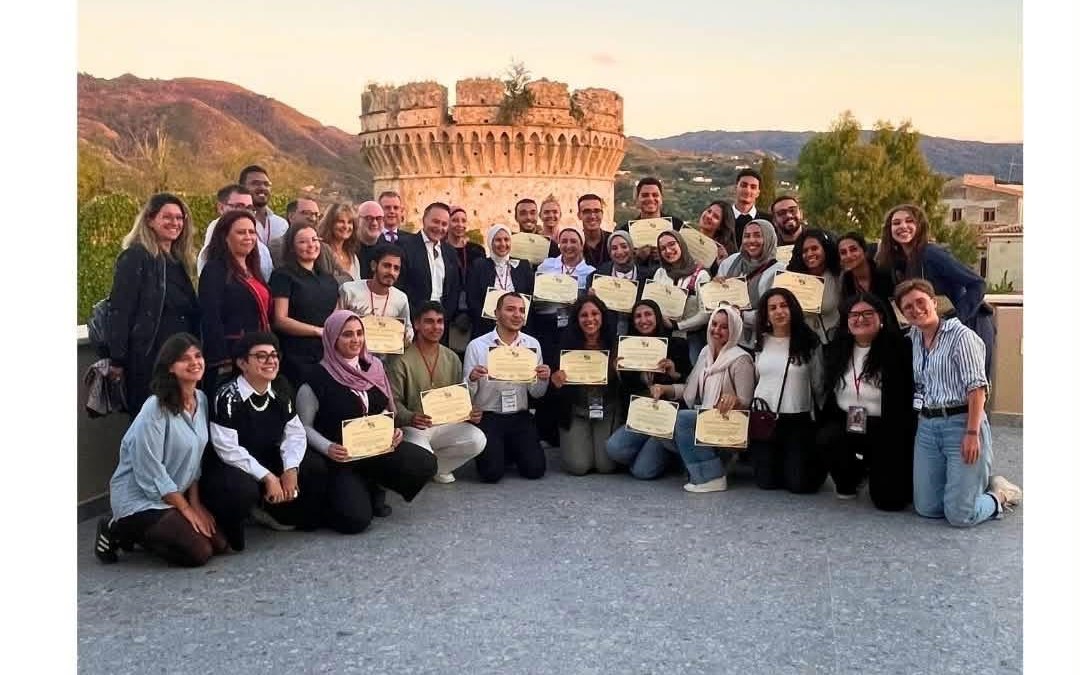
The certificate award ceremony, held on the Castle terrace against the backdrop of the Aragonese tower, thus marked the conclusion of the programme in Belvedere Marittimo, while entrusting the students and their forthcoming initiatives with the responsibility of carrying forward the experience and translating its lessons into concrete action.